San Diego Underpinning Get a Free Quote Get Matched Free

San Diego County, CA · Footings & Underpinning

Footing Repair San Diego: When a Crack Is Just a Crack

Footing repair in San Diego covers a wide range — from a simple concrete crack injection to full pier underpinning of a failed spread footing. This guide explains what a spread footing does, when concrete footing repair alone is enough, and when the soil beneath it has moved far enough that underpinning is the only real fix.

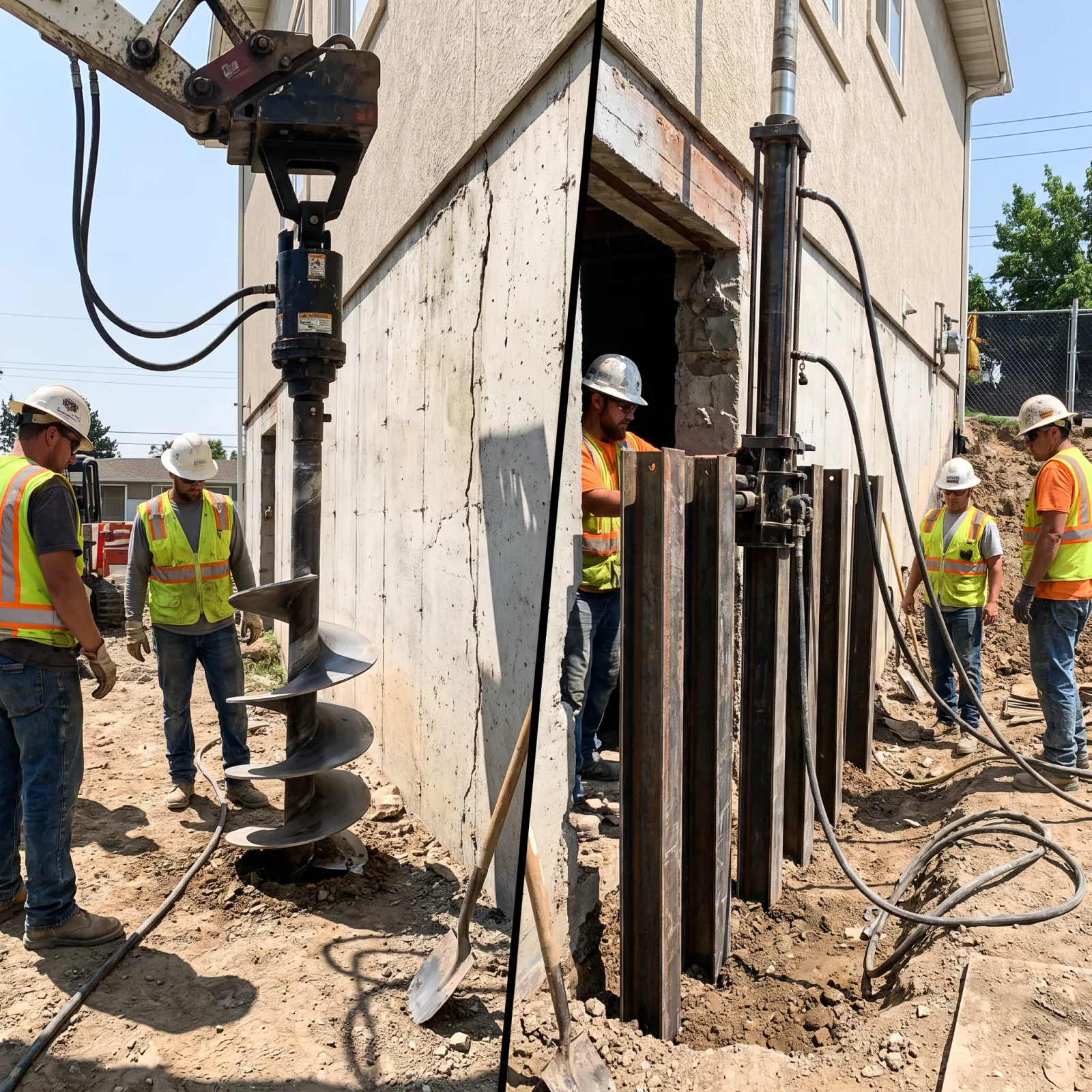
Helical pier being installed beside an existing concrete footing to underpin a settled foundation

What a Spread Footing Is, and Why It Fails

A spread footing is the widened concrete base beneath a foundation wall or column that spreads the building's load over a larger soil area. It fails when the soil beneath it can no longer support that load evenly — commonly from expansive clay, erosion at a canyon edge, or a footing undersized for a later remodel's added load.

Every foundation wall or isolated column footing in a residential structure is engineered against an assumed soil bearing capacity. San Diego's expansive coastal clays swell when wet and shrink when dry, and that cycling movement is what most commonly overwhelms a footing that was adequately sized when it was poured decades ago. On canyon-edge lots, a footing sitting partly on native ground and partly on engineered fill is a specific failure pattern, because the two materials settle at different rates under the same footing — see our canyon slope repair guide for that scenario in detail.

Concrete Footing Repair Without Piers: When It's Enough

A footing crack with no measurable settlement can sometimes be addressed with epoxy injection or a concrete patch to stop water intrusion, but that only treats the crack, not the underlying cause. If the footing has actually settled or the soil beneath it is still moving, patching the crack without addressing the soil is treating a symptom, and it will crack again.

The diagnostic test is the same one used for wall cracks: measure the crack width, mark it, and check again in a month. A hairline shrinkage crack in a footing that hasn't moved is a maintenance item — seal it against moisture and move on. A crack that's growing, or that coincides with a measurable floor-level differential nearby, means the footing itself has lost bearing capacity, and no amount of epoxy fixes that; the load path needs to be re-established somewhere the soil can actually carry it.

When Footing Repair Requires Underpinning

Underpinning becomes necessary when the existing footing can no longer be trusted to transfer load to stable soil — typically when settlement is ongoing, the footing depth was never adequate for the soil type, or a canyon-adjacent footing sits in fill that has shifted. Piers installed beneath or beside the existing footing bypass the compromised soil entirely.

This is the point where "footing repair" and "underpinning" become the same job. A helical or push pier is installed adjacent to the failing footing and mechanically connected to it with a bracket, so the pier — not the original soil — now carries that section's load down to a deeper bearing stratum. Compare the two systems on our helical vs. push pier guide to see which one an engineer is more likely to specify for your soil and access conditions.

Footing Repair Cost vs. Full Underpinning

A localized footing repair — crack injection or a small footing extension — commonly costs a fraction of full-perimeter underpinning, since it addresses one section rather than piering the whole foundation. See our full underpinning cost breakdown for per-pier pricing once a repair does require piers.

This is exactly why an accurate diagnosis matters before you get a bid: a contractor pricing "footing repair" without first establishing whether the soil beneath it is still moving can quote a crack-injection job that never solves the underlying problem, or quote full underpinning where a smaller localized fix would have been enough. An independent engineer's evaluation — see our foundation inspection guide — is the cheapest way to make sure the scope matches the actual cause before money changes hands.

Verify concrete and structural standards

Good to Know

Footing Repair — Frequently Asked Questions

What is a spread footing, and why does it fail?+

A spread footing is the widened concrete base beneath a foundation wall or column that spreads the building's load over a larger soil area. It fails when the soil beneath it can no longer support that load evenly — commonly from expansive clay swelling and shrinking, erosion or washout at a canyon edge, or a footing that was undersized for the load it now carries after a remodel.

Can a cracked footing be repaired without piers?+

A footing crack with no measurable settlement can sometimes be addressed with epoxy injection or a concrete patch to stop water intrusion, but that only treats the crack, not the underlying cause. If the footing has actually settled or the soil beneath it is still moving, patching the crack without addressing the soil is treating a symptom, and it will crack again.

When does footing repair require underpinning?+

Underpinning becomes necessary when the existing footing can no longer be trusted to transfer load to stable soil — typically when settlement is ongoing, the footing depth was never adequate for the soil type, or a canyon-adjacent footing sits in fill that has shifted. Piers installed beneath or beside the existing footing bypass the compromised soil and carry the load to a deeper, competent bearing layer.

What does footing repair cost compared to full underpinning?+

A localized footing repair — crack injection or a small footing extension — commonly costs a fraction of full-perimeter underpinning, since it addresses one section rather than piering the whole foundation. See our full underpinning cost breakdown for per-pier pricing once a repair does require piers.

Not sure if your footing needs a patch or a pier? Get a free, no-obligation evaluation.

Request a Free Contractor Match

Takes about 60 seconds.

Qualification

We match you with CSLB-licensed foundation contractors. By submitting, you consent to be contacted by phone, text, and email regarding your request. See our Privacy Policy.

Related guides