San Diego Underpinning Get Matched Free

San Diego County, CA · Structural Comparison

Helical Piers vs. Push Piers for San Diego Soils

Both systems transfer a building's load past unstable near-surface soil down to competent bearing material. They get there differently, and in San Diego County — expansive coastal clays, decades-old canyon fill, and hillside grading — that difference determines which one an engineer will specify. This page also covers what to do when a pre-sale inspection flags settlement mid-escrow.

What is the difference between helical piers and push piers?

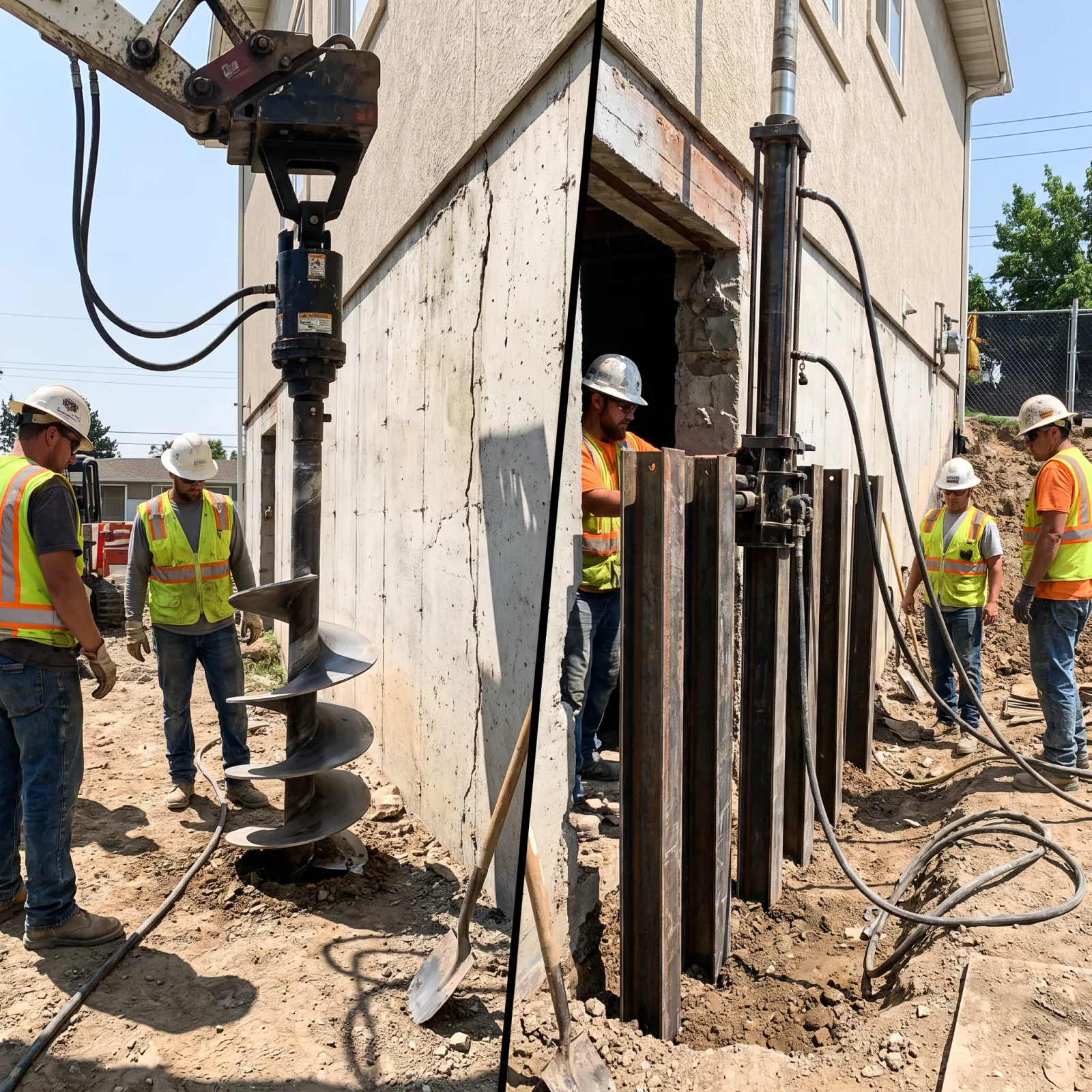
Push piers are hydraulically driven to depth using the weight of the structure as reaction, so capacity comes from end bearing. Helical piers are screwed in with a torque motor and derive capacity from helix plates in bearing soil, so they do not depend on structure weight.

That reaction difference drives everything else. Because a push pier borrows the building's own mass to advance the shaft, it effectively load-tests itself as it goes — the installer watches pressure climb as the pier meets resistance, and a heavy structure produces a confident refusal. On a light single-story wood-framed house, though, there may not be enough weight to drive the pier to real bearing, and you can get a shallow refusal that looks fine on the gauge and settles later. Helical piers sidestep that entirely: capacity is correlated to installation torque, which is measured independently of the structure. The tradeoff is that helical capacity depends on the helix plates finding suitable soil, so a poorly characterized profile can under-deliver in the other direction. In both cases the verification data — driving pressure or installation torque, recorded per pier — is what you want in the closeout documents.

Which pier type is better for San Diego coastal clay and canyon fill?

Neither is universally better; the soil profile decides. Helical piers are commonly favored on lighter structures and deep canyon fill where there is not enough building weight to drive push piers, while push piers suit heavier structures over a reachable competent bearing layer.

San Diego's two problem profiles pull in different directions. Expansive clay is a near-surface behavior problem — the soil swells wet and shrinks dry, cycling the foundation seasonally — and the answer is getting past the active zone to stable material, which either system can do if the depth is right. Canyon fill is a depth-and-quality problem: engineered fill can run deep and vary within a single lot, and its bearing capacity may be marginal well below the surface. That combination, deep and uncertain, is where helical piers' torque-verified installation is often preferred, especially under lighter structures. Where you have a heavy two-story home over formation soil at a reachable depth, push piers are frequently the more economical route. Treat any contractor who sells one system for every condition as a product vendor rather than a diagnostician, and let the geotechnical report and engineer make the call.

An escrow inspection flagged foundation settlement — what happens now?

A general inspector's note is not a diagnosis. The standard next step is a foundation evaluation with an elevation survey, and where movement is confirmed, an engineered repair plan that gives buyer, seller, and lender a defined scope and cost to negotiate against.

Escrow-period findings create pressure to act fast, and that pressure produces bad decisions in both directions — buyers walking from cosmetic cracking, or sellers agreeing to a credit with no idea whether it covers the work. The unlock is converting an ambiguous note into a scoped number. An elevation survey establishes how much differential movement exists; a geotechnical review establishes why; the engineered plan establishes what it takes to fix. With those in hand the negotiation becomes ordinary. Sequence matters when the clock is running: get the evaluation and survey started immediately, since permit plan check is the step most likely to outlast the escrow period. It is common and reasonable to close with a holdback or credit for permitted repairs completed after close rather than trying to compress engineering and permitting into the contingency window.

How long does pier installation take?

Field installation on a typical partial-perimeter residential job is usually measured in days rather than weeks. The longer part of the schedule is almost always the geotechnical report, engineered plan, and permit plan check that must all precede any work in the field.

Homeowners consistently underestimate the front half of the timeline and overestimate the back half. Excavating access pits, advancing piers, load testing, transferring the load, and backfilling is disruptive but comparatively quick; you are not living through months of construction. Getting to that point involves scheduling a geotechnical firm, waiting on lab results and a written report, engineering turnaround, and municipal plan check — a sequence with real queue time at every stage. Two things shorten it: starting the geotechnical work the moment you suspect a problem rather than after collecting bids, and hiring a contractor who regularly permits in your specific jurisdiction and already knows what that plan checker will flag. See permit and engineering costs →

Helical piers compared with push piers for San Diego County foundation underpinning
Factor Helical Piers Push Piers
Installation method Screwed in with a torque motor Hydraulically driven against structure weight
Capacity verified by Installation torque, recorded per pier Driving pressure at refusal, recorded per pier
Needs building weight? No — works under light structures Yes — heavier structures drive better
Common San Diego fit Canyon fill, light framing, new-build support Heavier homes over reachable bearing strata
Also used for lateral loads Yes — as tiebacks on slopes and walls No — vertical support only
Typical installed cost each $1,500 – $3,000 $1,200 – $2,500

System selection is an engineering decision based on your geotechnical report — this comparison is general guidance, not a specification.