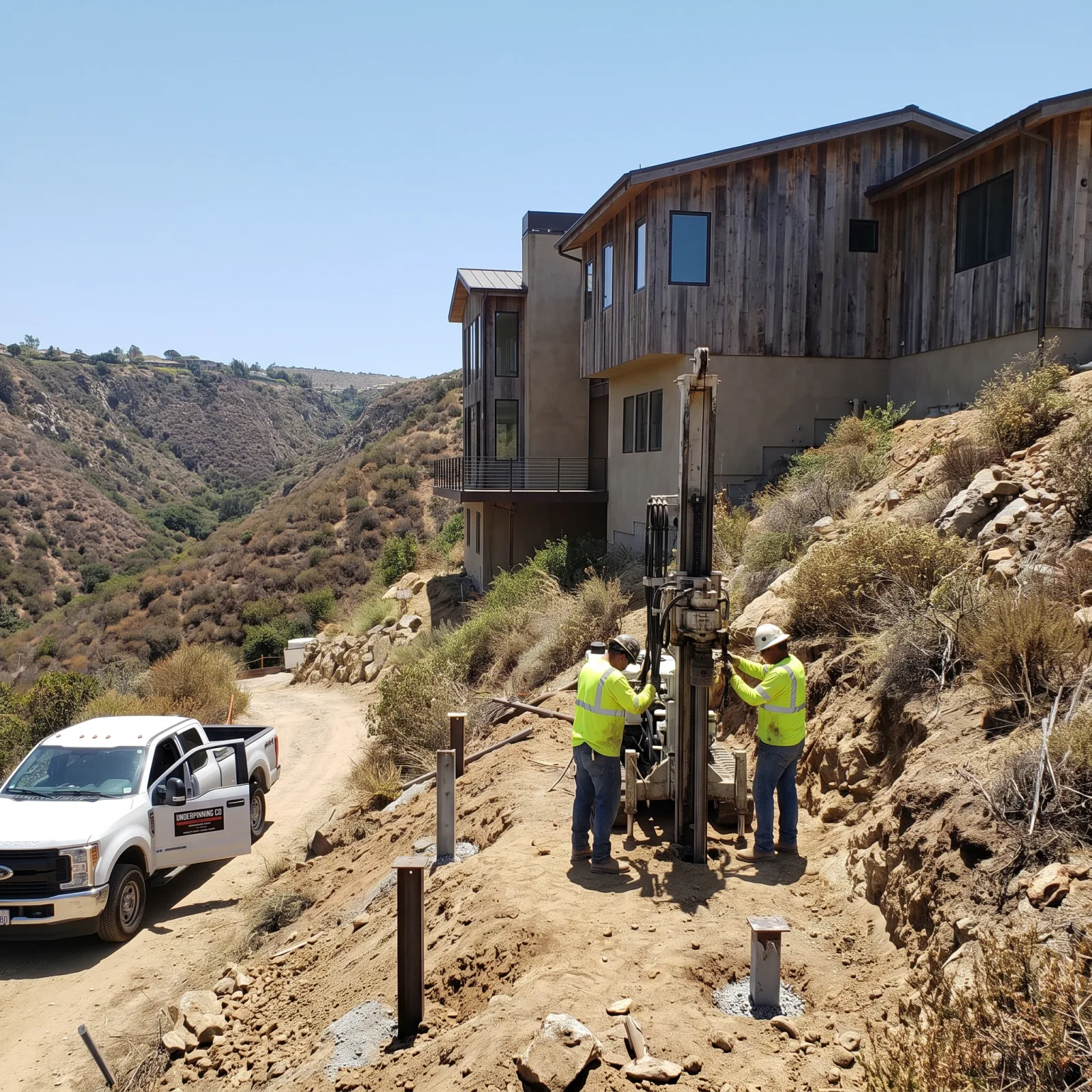
Slope Foundation Repair San Diego: Why Canyon Lots Settle More Than Flat Lots
Many San Diego canyon-edge homes sit partly on engineered fill placed during grading decades ago. Fill compacts over time and holds water differently than the native formation beside it, so one side of a foundation can settle while the other stays put.
That split-support condition is what makes canyon settlement so recognizable. A house resting entirely on fill often settles more or less uniformly and shows relatively little distress; a house straddling the cut-fill transition line racks and twists, which is why the cracking concentrates at one corner and the doors stick only on the downhill side. Add San Diego's expansive clays — which swell in the wet season and shrink through the dry months — and the fill side of the house rides a seasonal cycle the cut side does not. The practical implication for repair: spot patching the cracks treats the symptom while the transition line keeps working. Any real fix has to get the settling portion of the foundation onto the same competent bearing layer the stable portion already sits on.